A writer inspired by nature and human nature

Archive for the ‘Writing Challenges’ Category

As a Writer, Do You Make Time To Read?


Every #writer should #read this article by author Don Massenzio at DSM Publications! ~Bette A. Stevens, Maine author

Don Massenzio's avatarDSM Publications

Anyone who knows me, knows that I am an avid reader as well as a writer. I tend to pick authors that I enjoy and read their entire body of work in chronological order. This not only brings me enjoyment, but it shows me their development as an author from their early to contemporary work.

One of my favorite authors is Stephen King. His early work is strong and definitely got stronger. When he suffered his accident and nearly died, his work suffered a bit after his recovery. He even threatened to retire, but thankfully, did not. I use him as an example because he also has one of my favorite quotes by an author:

If you don’t have time to read, you don’t have the time — or the tools — to write. Simple as that. – Stephen King

In the past eight months, I have written and published…

View original post 773 more words

Aside

3 Day Quote Challenge – Day Three


Aside

3 Day Quote Challenge – Day Two


Thank you Deborah—Author of A Wise Woman’s Journey.

Day Two Quote: –

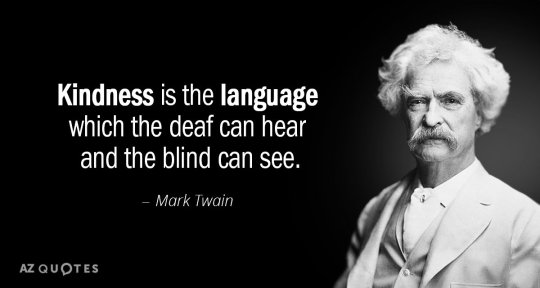
If a child is to keep alive his inborn sense of wonder, he needs the companionship of at least one adult who can share it, rediscovering with him the joy, excitement, and mystery of the world we live in. ~Rachel Carson


I nominate:

1.  Janice Spina  – Author of Jemsbooks

2.  Maretha Botha – Author at  Maretha Botha 

3.  D.L. Flinn  – Author at Embrace Your Inner Child

Photo Credit: AZ QUOTES

[Explore Bette’s Blog]


Aside

3 Day Quote Challenge – Day One


Aside

A Sense of Style


“Style is a very simple matter…” Discover the secrets in this precise and concise post from author L.M. Nelson! ~Bette A. Stevens, Maine author http://www.4writersandreaders.com

L.M. Nelson's avatarlmnelsonscorner

Image result for got style

In the writing world, the word style means the way in which an idea is expressed. Style has to do with form, not content. Readers pick up a book because of content, but put it down because of style.

As a writer, you have to develop your own writing style. The way you arrange words is the nature of you. Your style should be specifically yours and no one else’s.

When developing your individual style, here are some things to consider:

  1. Listen to what you write. Writing is like music. The words you write make sounds, and when those sounds are  in harmony, the writing works.
  2. Mimic spoken language. Writing convey to the reader the sense of conversation. It should provide the intimacy and warmth of personal conversation.
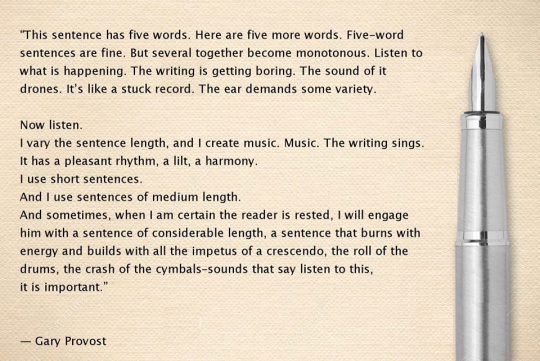
  3. Vary sentence length. Consider the following:Image result for vary sentence length
  4. Vary sentence construction. You should always strive for clarity when you write…

View original post 188 more words

Aside

#NationalPoetryMonth: Write a Spring Haiku & Get the Kids Writing Too!


Celebrate National Poetry Month with a Haiku or Two!

Springtime Melodies

Haiku from MY MAINE (Poetry & Photography Collection) by Bette A. Stevens

Sunbeams composing
Springtime melodies, humming
Tapping to the tunes

I love designing posters to go with my poems and often use photos I have taken. As a former teacher (now retired) in grades four through eight, I know that kids of all ages love writing poetry and they enjoy illustrating their poems too. It’s simple and it’s so much fun to tell a story in the three short lines of Haiku. Of course, you can write as many stanzas as you wish. Give it a try! 

Grab the kids, take out your pens, head into the great outdoors and get inspired!

~Bette A. Stevens, Maine author/illustrator

Take a look inside MY MAINE, Haiku through the Seasons

(Haiku: m)

haiku

noun hai·ku ˈhī-(ˌ)kü

  1. :  an unrhymed verse form of Japanese origin having three lines containing usually five, seven, and five syllables respectively; also :  a poem in this form usually having a seasonal reference — compare tanka


Discover more about how to write haiku and other poetry

[Explore Bette’s Blog]

Save

Save

Save

Save

Save

Aside

Write a Spring Haiku & Get the Kids Writing Too!


Celebrate National Poetry Month!

Countdown Commences (Spring Haiku) by Bette A. Stevens

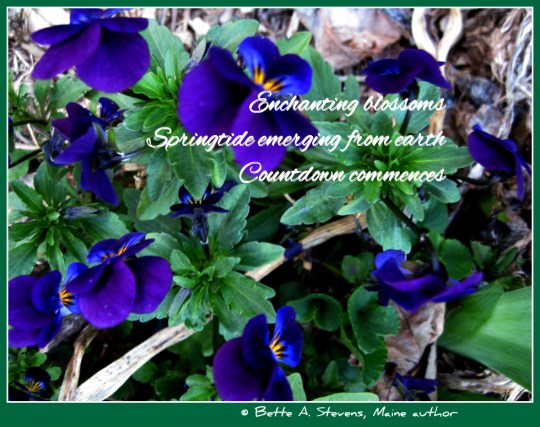
Happy April and Happy National Poetry Month. Snow pack is still in meltdown stage here at the farmstead in Central Maine, but spring blooms will soon be appearing. Johnny-jump-ups (like the ones I photographed on the poster) are sure to be among the first blooms of the season. They’re one of those hardy native plants that bloom in abundance and pop up everywhere from early spring until the first hard freeze the next fall—hence the title and last line of the poem. This photo of last year’s blooms inspired me to write countdown Commences,  a spring haiku (Japanese-inspired, non-rhyming three-line: 5-7-5 syllable poem).

Countdown Commences

Haiku by Bette A. Stevens

Enchanting blossoms
Springtide emerging from earth
Countdown commences

I love designing  posters to go with my poems and often use photos I have taken. As a former teacher (now retired) in grades four through eight, I know that kids of all ages love writing poetry and they enjoy illustrating their poems too. It’s simple and it’s so much fun to tell a story in the three short lines of Haiku. Of course, you can write as many stanzas as you wish. Give it a try! 

Grab the kids, take out your pens, head into the great outdoors and get inspired!

~Bette A. Stevens, Maine author/illustrator

(Haiku: m)

haiku

noun hai·ku \ˈhī-(ˌ)kü\

  1. :  an unrhymed verse form of Japanese origin having three lines containing usually five, seven, and five syllables respectively; also :  a poem in this form usually having a seasonal reference — compare tanka


Discover more about how to write haiku and other poetry

[Explore Bette’s Blog]

Save

Save

Save

Save

Save

Aside

Top 3 Books For Writers


Featured Image -- 8009Don’t miss any of these. King’s and White’s are top go-to’s on my shelf and I’ve just ordered Lammott’s Bird by Bird today. Happy reading and writing every day… ~Bette A. Stevens http://www.4writersandreaders.com

Aside

How Reading Rewires Your Brain


Don’t miss this post from M.C. Tuggle... Bette A. Stevens, Maine author http://www.4writersandreaders.com

Excerpt: “In the United States — yes, the United States — 1 out of 4 children grow up without learning to read. That’s intolerable. Want to do your part to make the world a better and happier place? Read, and do what you can to help others read. ”

Mike's avatarM.C. Tuggle, Writer

Reading

There is no doubt in my mind that modern society traps its subjects in an unhealthy and unsuitable environment. That stark realization motivates many of my stories (see here and here, for example). The most disturbing symptom of how toxic our culture has become is the increasingly acerbic mutual distrust evident in current politics. Little wonder so many feel depressed, powerless, and alienated.

Rather than utilizing technology to better our lives, we let it rule us. Distracted by smart phones, buffeted by inescapable sensory overload, and hobbling our discourse in 140-character outbursts at each other, we’re incapable of understanding our own inner selves, much less that of others.

Fortunately, the tonic for the condition we find ourselves in is close at hand — if only we would use it, as this eye-opening piece in big think proclaims:

Research shows that reading not only helps with fluid intelligence, but with…

View original post 199 more words

Aside

Write a Summer Limerick & Get the Kids Writing Too!


HAVE FUN WRITING LIMERICKS

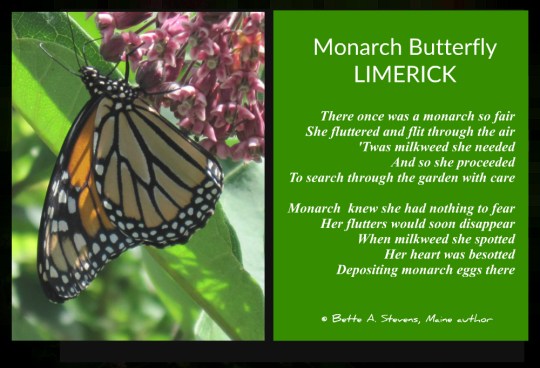
Monarch Butterfly LIMERICK 2 bas 2017

Summertime is fun time! And with ‘back to school’ just around the corner, it’s a great time to write limericks and get the kids writing too…

Whether you’re a writer, a reader, a teacher, a parent or simply want to share the love of reading and writing, get the kids together and give “Limericks” a try. You’ll be glad you did!

Some of my favorite things about summer are butterflies, long lazy summer days, gardens and sunshine. I love to sit on the porch with my camera at the ready just in case I spot an amazing monarch or any of our sensational butterfly friends dropping by to enjoy the view. So far this year I’ve spotted twelve monarchs and dozens of other butterflies too—and managed to capture several of these exquisite creatures with my Canon “PowerShot.”

Butterflies are very sensitive to the environment and with their natural habitat areas being increasingly eroded and with significantly greater use of chemicals, our butterfly population is in decline. Planting and cultivating milkweed (Monarch caterpillars need milkweed) and other blooms that our pollinators need for survival is one way that I can help.

Limerick (poetic definition)

[lim-er-ik]
noun
1. a kind of humorous verse of five lines, in which the first, second, and fifth lines rhyme with each other, and the third and fourth lines, which are shorter, form a rhymed couplet.


My limerick is about one of the monarch butterflies (captured by my camera) that fluttered through my garden so far this summer. I had fun writing two verses to tell my monarch’s story. Check out the link at the end of the post to find out more about poetic limericks.

A Monarch Butterfly Limerick

by Bette A. Stevens

There once was a monarch so fair

She fluttered and flit through the air

’Twas milkweed she needed

And so she proceeded

To search through the garden with care


Monarch  knew she had nothing to fear

Her flutters would soon disappear

When milkweed she spotted

Her heart was besotted

Depositing monarch eggs there


WRITING POETRY WITH CHILDREN

Tips & Tools

When teaching (grades 4-8), I found that writing poems and sharing them was an exciting way get children of all ages hooked on writing. I must admit it—limericks are so much fun to write and to share! In the classroom we learn about using some of the tools in our writer’s tool box—literary devices like assonance (repeating vowel sounds) and consonance (repeating consonant sounds) to create a musical message. And of course, we had Scholastic rhyming dictionaries and thesauruses close at hand. It’s always exciting to discover alternative words (synonyms) that have just the right sounds and syllables to perfect our poems.

Whether you’re a writer, a reader, a teacher, a parent or simply want to share the love of reading and writing, get the kids together and give it a try. You’ll be glad you did!


Click the link to find out all about it How to Write a Limerick http://www.poetry4kids.com/blog/lessons/how-to-write-a-limerick/

[Explore Bette’s Blog]

Save

Save

Save

Save

Save

Save

Save

Save

Save

Save
Save

Save

Tag Cloud