A writer inspired by nature and human nature

Archive for the ‘Writing Challenges’ Category

Write a Spring Haiku & Get the Kids Writing Too!


Celebrating International Haiku Poetry Day!
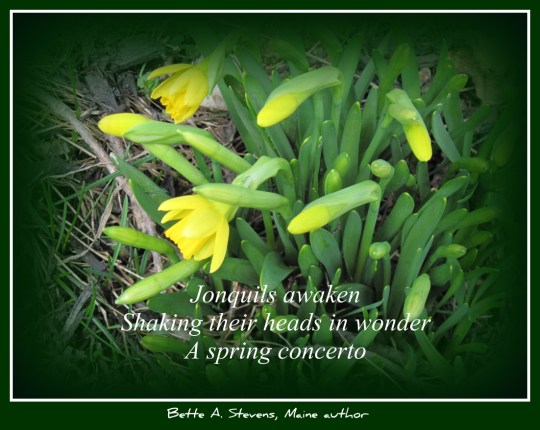
As I wandered out into the garden with my trusty camera early this morning, much to my surprise, an icy blanket at the edge of the rock garden had melted and a family of opening jonquils greeted me with their smiles. Being the first blooms of the season, they simply made my day and inspired me to write “A Spring Concerto,”  a haiku (Japanese-inspired, non-rhyming three-line: 5-7-5 syllable poem).

A Spring Concerto
HAIKU by Bette A. Stevens

Jonquils awaken

Shaking their heads in wonder

A spring concerto

Personally, I love designing  posters to go with my poems and often use photos I have taken. As a former teacher (now retired) in grades four through eight, I know that kids of all ages love writing poetry and they enjoy illustrating their poems too. It’s simple and it’s so much fun to tell a story in the three short lines of Haiku. Of course, you can write as many stanzas as you wish. Today’s a perfect day for you to give it a try.

Get out your pen, get outdoors in nature, get inspired…and get the kids writing haiku too!

~Bette A. Stevens, Maine author/illustrator

(Haiku: m)

haiku

noun hai·ku \ˈhī-(ˌ)kü\

plural

haiku

  1. :  an unrhymed verse form of Japanese origin having three lines containing usually five, seven, and five syllables respectively; also :  a poem in this form usually having a seasonal reference — compare tanka


Discover more about how to write haiku and other poetry:

Find out more about International Haiku Poetry Day

[Explore Bette’s Blog]
Save

Save

Save

Save

Save

2017 WRITING CONTEST: Tales2Inspire Celebrates Sixth Year


Get ready to share your story

winner-tales2inspire


“So much more than a contest

Lois W. Stern announces the opening of Tales2Inspire’s sixth yearwith a great little contest for those with an inspiring story to share. But it is so much more than a contest, as winning authors get tons of publicity to help them on their paths to discovery. Free to enter—NO FEES involved.

Stories must be true, with one or more relevant photos submitted to enhance the impact of the story. All details posted at: www.tales2inspire.com/contest, so please refer to this link before you begin.

And since a picture is worth 10,000 words, while you’re there, grab a F*R*E*E e-book sampler of inspiring stories written by previous winners, and now published in one of the six Tales2Inspire® collections

~ Lois W. Stern
Creator of Tales2Inspire ‘Authors Helping Authors’ Project/Contest

Get the NEW Tales2Inspire E-book 6 Inspiring Stories – FREE 
Available formats for KINDLE (Mobi) OR NOOK (e-pub)
FREE e-book sampler www.tales2inspire.com/gift
Your reviews are most appreciated.

    Lois’s links:

[Explore Bette’s Blog]

Save

Save

Save

Save

Save

Save

Save

Save

Save

Save

Save

Save

Save

Save

Save

Save

Save

Save

Save

Save

Save

Save

Save

Save

Save

Save

Save

Save

Save

Save

Aside

Have Fun Writing Haiku & Get the Kids Writing Too!


Write a Halloween Haiku & Get the Kids Writing Too!

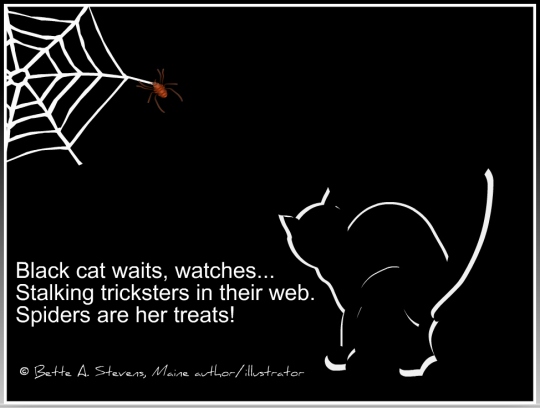
black-cat-halloween-haiku-bas-2016Midnight—my fabulous furry feline—inspired me to write BLACK CAT, a Halloween haiku (Haiku: a Japanese-inspired three-line: 5-7-5 syllable poetry form) and design a poster to go with the poem. Kids love illustrating their poetry.

What’s inspiring you this Halloween?
Brainstorm your list and get writing.
Have fun—don’t forget to get the kids writing too!

Here are some writer’s tricks (literary devices found in every writer’s toolbox) I used to create BLACK CAT. These tools can set a mood— they make writing and reading memorable and fun.  Check them out and see if you can discover where I used them in my poem.

Read on to find out more about these literary devices.

Black cat waits, watches…
Stalking tricksters in their web.
Spiders are her treats!

Three Writer’s Tricks (Literary devices) used in writing poetry and prose

Assonance
Assonance is the repetition of vowel sounds in nearby words.

Consonance
Another literary device used by writers and poets is consonance. It is the repetition of the final consonant sounds, usually in the more important words or in the accented syllables.

Alliteration
You put your alliteration tool to work when words that start with the same sound are used close together in a phrase or sentence. The sound is usually a consonant and the words don’t have to always be right next to one another.

Finding “just the right words”
Abundant resources are available in print as well as through online searches. Listed below are the two resources I had readily available in the classroom for my students (Grades 4-8). Paperbacks are inexpensive enough to have multiple copies available, and in my opinion, they are indispensable.

  • The Scholastic Rhyming Dictionary by Sue Young
  • Webster’s Thesaurus for Students by Merriam-Webster

                        Happy Writing and Reading Haiku

                                    & Happy Halloween!

                     ~ Bette A. Stevens, Maine author/illustrator

[Explore Bette’s Blog]

Save

Save

Save

Save

Save

Save

Save

Save

Save

Save

Save

Save

Save

Save

Save

Save

Save

Save

Save

Save

Save

Save

Aside

Write an Autumn Haiku!


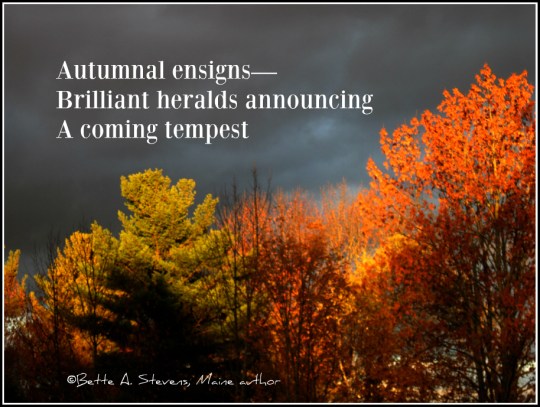
Autumnal Ensigns (a haiku by Bette A. Stevens)

Photo and Haiku by Bette A. Stevens Autumn’s vibrant display of colors never fails to inspire and writing Haiku (a Japanese-inspired three-line: 5-7-5 syllable poetry form) is one of my favorite ways to capture nature’s stories. Haikus are usually written about nature. Here’s what I came up with this week. What’s inspiring you this autumn? ~ Bette A. Stevens, Maine author/illustrator
Happy Haiku Writing!

  • Find out more about how to write haiku and other poetry at Reference.Com

[Visit Bette’s Blog]

Save

Save

Save

Aside

Write a Limerick!


SPIDER Limerick 3 BAS 2016

 Write a limerick?

Why not! I thought it would be fun to share a limerick this week and invite you to write one too. Mine is about me and a spider.

When teaching (grades 4-8), I found that starting a new school year by writing poems and sharing them was an exciting way get students hooked on writing. I must admit it—limericks are so much fun! In the classroom we learn about using some of the tools in our writer’s tool box—tools like assonance (repeating vowel sounds) and consonance (repeating consonant sounds) to create a musical message. And of course, we had Scholastic rhyming dictionaries and thesauruses close at hand. It’s always exciting to discover alternative words (synonyms) that have just the right sounds and syllables to perfect our poems.

Whether you’re a teacher, a parent or simply want to share the love of reading and writing, get the kids together and give it a try. Read on to discover what inspired me to write my spider limerick and have lots of fun writing and reading with the kids!

Click the link to find out all about it How to Write a Limerick http://www.poetry4kids.com/blog/lessons/how-to-write-a-limerick/

More about Bette’s Spider Limerick

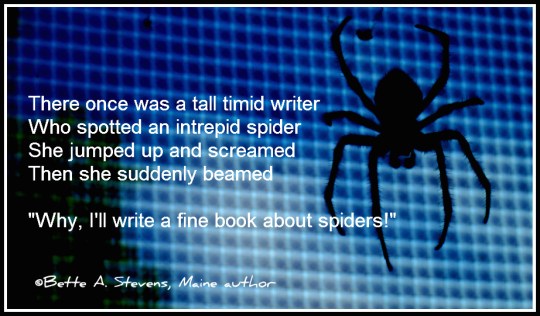
Before I wrote this limerick, I had been watching several spiders weave their webs on the outside screens of our back porch all during the spring and summer. Spiders are fascinating creatures to watch from a safe distance. But, up close and personal they frighten me. The photo for the limerick was taken by me (safely inside the screen). Nature and my own human nature inspired me to write this one:

There once was a tall timid writer
Who spotted an intrepid spider
She jumped up and screamed
Then she suddenly beamed
“Why, I’ll write a fine book about spiders!”

~ Bette A. Stevens

[Explore Bette’s Blog]

Save

Save

Save

Save

Save

Save

Save

Save

Save

Save

Save

Save

Save

Save

Save

Save

Save

10 Free Writing Contests with Cash Prizes — Silver Threading ~ Fairy Whisperer ~ Writer, Poet, & Book Reviewer


Great news! More writing contests with CASH Prizes! WOO HOO!❤ Source: 10 Free Writing Contests with Cash Prizes

via 10 Free Writing Contests with Cash Prizes — Silver Threading ~ Fairy Whisperer ~ Writer, Poet, & Book Reviewer

DIRECT LINK to CONTESTS http://www.freedomwithwriting.com/freedom/uncategorized/10-free-writing-contests-with-cash-prizes/   Happy Writing and Good Luck! ❤ Bette

Encourage a Young Writer Day


#EncourageAYoungWriterDay every day! ~ Bette Stevens, Maine author/illustrator http://www.4writersandreaders.com

Annette Rochelle Aben's avatarAnnette Rochelle Aben

EAYWD

It has been said, that on every April 10th, we celebrate National Encourage a Young Writer Day, funny thing is, I’ve been unable to track down the origins of this auspicious day. Oh sure I found celebrations dating back to 2013, 2014 and 2015, yet nothing to indicate who started this tradition So guess what? This gives us the opportunity to initiate a tradition of our own right here and now!

It IS up to us to encourage young writers and not just for a day but each and every day.  Young writers have an illustrious history of contributing to our literary world. After all, Anne Frank was a mere 13 years old when she penned her poignant diary, giving us a glimpse into a world many of us, thank goodness, would never experience.  And Stephen King, it is reported, sold his first story for the…

View original post 921 more words

Aside

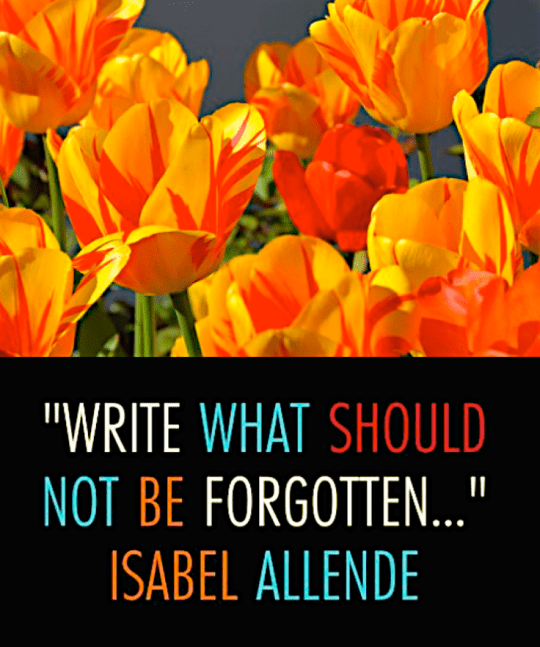
Write what…


Keep writing! ~ Bette A. Stevens, Maine author/illustrator http://www.4writersandreaders.com
nataliescarberry's avatarSacred Touches

Screen Shot 2016-03-29 at 10.59.27 PM.png**Image of tulips found on Pixabay; text box via Pinterest
View original post

Aside

10 reasons why YOU should join RAVE REVIEWS BOOK CLUB (even if you’re NOT a writer!)


Writers & Readers: COME JOIN US
Find out why membership is a no-brainer… #RaveReviewsBookClub ROCKS! ~ Bette A. Stevens [Explore Bette’s Blog]

Jan Hawke's avatarJan Hawke INKorporated

1 ~ The Book Club Selections for Review Catalog

There are over 400 members of RRBC and most of them are independent writers and/or publishers. The book catalog has far more than 400 titles in it, from all fiction genres (including Erotica, subject to Club Policy) YA (new Adult), and non-fiction. What I can’t give you is the link to our main catalog page – only members have access rights to this, so it’s literally an exclusive library for us RRBC people to discover, fresh, exciting new authors and titles. Prospective members can however view our genre pages for a taster! 😀
CLICK HERE for RRBC to join now!

2 ~ Your Fellow Members are AWESOME!

Because the RRBC site is a blog, there’s plenty of little nooks around for you to interact with your fellow members, such as – Book Chat; Peer Support; Social Media…

View original post 1,270 more words

To Rhyme or not to rhyme, that is the question . . .


Yay! A poetry contest. And I’m off to enter one of mine! ~ Bette A. Stevens http://www.4writersandreaders.com

AuthorJoePerroneJr's avatarAuthor Joe Perrone Jr's Blog

The Merriam-Webster Dictionary defines poetry as “writing that formulates a concentrated imaginative awareness of experience in language chosen and arranged to create a specific emotional response through meaning, sound, and rhythm.”  Huh?  What’d he say?  Let’s try Wikipedia for a more comprehensive definition.  It defines poetry as “a form of literature that uses aesthetic and rhythmic qualities of language—such as phonaesthetics, sound symbolism, and [sic] metre—to evoke meanings in addition to, or in place of, the prosaïc ostensible meaning.”  Not much better, is it?  (No wonder Wikipedia is called the “free” encyclopedia.)

Most of us believe we can identify poetry when we see it—or at least recognize it when we hear it— why then is it so difficult to define?  After all, if it rhymes, it’s poetry, right?  Not so fast, partner.  YourDictionary.com states categorically that there are “over 50 types of poetry.”  One of those is Haiku, a form of poetry that originated in Japan.  It…

View original post 448 more words

Tag Cloud