A writer inspired by nature and human nature

Archive for the ‘Writing Tips’ Category

As a Writer, Do You Make Time To Read?


Every #writer should #read this article by author Don Massenzio at DSM Publications! ~Bette A. Stevens, Maine author

Don Massenzio's avatarDSM Publications

Anyone who knows me, knows that I am an avid reader as well as a writer. I tend to pick authors that I enjoy and read their entire body of work in chronological order. This not only brings me enjoyment, but it shows me their development as an author from their early to contemporary work.

One of my favorite authors is Stephen King. His early work is strong and definitely got stronger. When he suffered his accident and nearly died, his work suffered a bit after his recovery. He even threatened to retire, but thankfully, did not. I use him as an example because he also has one of my favorite quotes by an author:

If you don’t have time to read, you don’t have the time — or the tools — to write. Simple as that. – Stephen King

In the past eight months, I have written and published…

View original post 773 more words

Aside

Write a Spring Haiku & Get the Kids Writing Too!


Celebrate National Poetry Month!

Countdown Commences (Spring Haiku) by Bette A. Stevens

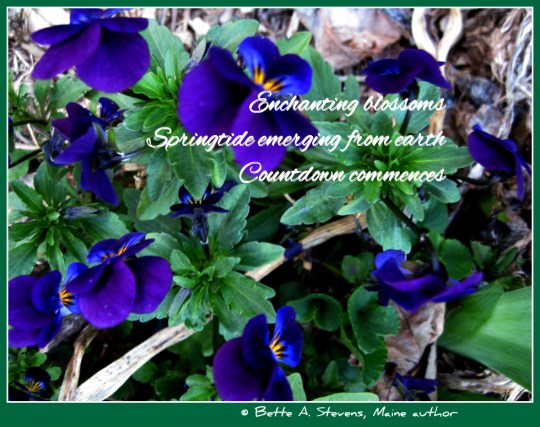
Happy April and Happy National Poetry Month. Snow pack is still in meltdown stage here at the farmstead in Central Maine, but spring blooms will soon be appearing. Johnny-jump-ups (like the ones I photographed on the poster) are sure to be among the first blooms of the season. They’re one of those hardy native plants that bloom in abundance and pop up everywhere from early spring until the first hard freeze the next fall—hence the title and last line of the poem. This photo of last year’s blooms inspired me to write countdown Commences,  a spring haiku (Japanese-inspired, non-rhyming three-line: 5-7-5 syllable poem).

Countdown Commences

Haiku by Bette A. Stevens

Enchanting blossoms
Springtide emerging from earth
Countdown commences

I love designing  posters to go with my poems and often use photos I have taken. As a former teacher (now retired) in grades four through eight, I know that kids of all ages love writing poetry and they enjoy illustrating their poems too. It’s simple and it’s so much fun to tell a story in the three short lines of Haiku. Of course, you can write as many stanzas as you wish. Give it a try! 

Grab the kids, take out your pens, head into the great outdoors and get inspired!

~Bette A. Stevens, Maine author/illustrator

(Haiku: m)

haiku

noun hai·ku \ˈhī-(ˌ)kü\

  1. :  an unrhymed verse form of Japanese origin having three lines containing usually five, seven, and five syllables respectively; also :  a poem in this form usually having a seasonal reference — compare tanka


Discover more about how to write haiku and other poetry

[Explore Bette’s Blog]

Save

Save

Save

Save

Save

Aside

#NationalPoetryMonth: Write a Spring Haiku & Get the Kids Writing Too!


Celebrate National Poetry Month with a Haiku or Two!

Springtime Melodies

Haiku from MY MAINE (Poetry & Photography Collection) by Bette A. Stevens

Sunbeams composing
Springtime melodies, humming
Tapping to the tunes

I love designing posters to go with my poems and often use photos I have taken. As a former teacher (now retired) in grades four through eight, I know that kids of all ages love writing poetry and they enjoy illustrating their poems too. It’s simple and it’s so much fun to tell a story in the three short lines of Haiku. Of course, you can write as many stanzas as you wish. Give it a try! 

Grab the kids, take out your pens, head into the great outdoors and get inspired!

~Bette A. Stevens, Maine author/illustrator

Take a look inside MY MAINE, Haiku through the Seasons

(Haiku: m)

haiku

noun hai·ku ˈhī-(ˌ)kü

  1. :  an unrhymed verse form of Japanese origin having three lines containing usually five, seven, and five syllables respectively; also :  a poem in this form usually having a seasonal reference — compare tanka


Discover more about how to write haiku and other poetry

[Explore Bette’s Blog]

Save

Save

Save

Save

Save

Aside

Top 3 Books For Writers


Featured Image -- 8009Don’t miss any of these. King’s and White’s are top go-to’s on my shelf and I’ve just ordered Lammott’s Bird by Bird today. Happy reading and writing every day… ~Bette A. Stevens http://www.4writersandreaders.com

Aside

Sky Stories (Haiku) by Bette A. Stevens


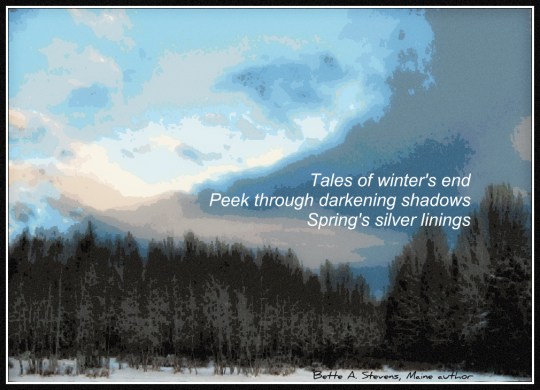
After three glorious days of 40 degree temperatures, the snow pack in the fields and front yard is beginning to melt at the farmstead in Central Maine. In fact, this was the first day I didn’t have to don ice cleats to walk safely down the driveway to the mailbox—the sun was shining and nary a cloud in the sky. By late afternoon the sky was telling another story. What stories are the skies telling you? ~Bette A. Stevens, Maine author

Here’s my latest haiku. See if you can write one too!

Sky Stories

Tales of winter’s end
Peek through darkening shadows
Spring’s silver linings

Discover more about how to write haiku and other poetry:

Find out more about author Bette A. Stevens and her books at http://viewauthor.at/BetteAStevens

[Explore Bette’s Blog]

Aside

Writing Haiku: Winter Ensemble (Haiku) by Bette A. Stevens


Enjoying another snow day at the farmstead in Central Maine. My current WIP (work in progress) is a poetry collection that I plan to publish this year. The photo shows the east side of our barn (I love that spruce tree we planted a few years back.) here at the farmstead.  Today I’ve written Winter Ensemble and invite you to join the fun and write a haiku too. If the kids are around, you can make it a family affair—get them writing haiku with you!

Nor’easterly winds
Lead frozen boughs in tempo
Winter ensemble

~Bette A. Stevens

HAIKU

noun hai·ku \ˈhī-(ˌ)kü\
  1. :  an unrhymed verse form of Japanese origin having three lines containing usually five, seven, and five syllables respectively; also :  a poem in this form usually having a seasonal reference — compare tanka

Discover more about how to write haiku and other poetry:

[EXPLORE BETTE’S BLOG]

Aside

Write a Summer Limerick & Get the Kids Writing Too!


HAVE FUN WRITING LIMERICKS

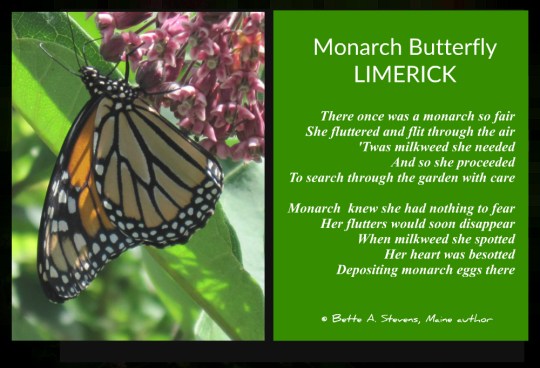
Monarch Butterfly LIMERICK 2 bas 2017

Summertime is fun time! And with ‘back to school’ just around the corner, it’s a great time to write limericks and get the kids writing too…

Whether you’re a writer, a reader, a teacher, a parent or simply want to share the love of reading and writing, get the kids together and give “Limericks” a try. You’ll be glad you did!

Some of my favorite things about summer are butterflies, long lazy summer days, gardens and sunshine. I love to sit on the porch with my camera at the ready just in case I spot an amazing monarch or any of our sensational butterfly friends dropping by to enjoy the view. So far this year I’ve spotted twelve monarchs and dozens of other butterflies too—and managed to capture several of these exquisite creatures with my Canon “PowerShot.”

Butterflies are very sensitive to the environment and with their natural habitat areas being increasingly eroded and with significantly greater use of chemicals, our butterfly population is in decline. Planting and cultivating milkweed (Monarch caterpillars need milkweed) and other blooms that our pollinators need for survival is one way that I can help.

Limerick (poetic definition)

[lim-er-ik]
noun
1. a kind of humorous verse of five lines, in which the first, second, and fifth lines rhyme with each other, and the third and fourth lines, which are shorter, form a rhymed couplet.


My limerick is about one of the monarch butterflies (captured by my camera) that fluttered through my garden so far this summer. I had fun writing two verses to tell my monarch’s story. Check out the link at the end of the post to find out more about poetic limericks.

A Monarch Butterfly Limerick

by Bette A. Stevens

There once was a monarch so fair

She fluttered and flit through the air

’Twas milkweed she needed

And so she proceeded

To search through the garden with care


Monarch  knew she had nothing to fear

Her flutters would soon disappear

When milkweed she spotted

Her heart was besotted

Depositing monarch eggs there


WRITING POETRY WITH CHILDREN

Tips & Tools

When teaching (grades 4-8), I found that writing poems and sharing them was an exciting way get children of all ages hooked on writing. I must admit it—limericks are so much fun to write and to share! In the classroom we learn about using some of the tools in our writer’s tool box—literary devices like assonance (repeating vowel sounds) and consonance (repeating consonant sounds) to create a musical message. And of course, we had Scholastic rhyming dictionaries and thesauruses close at hand. It’s always exciting to discover alternative words (synonyms) that have just the right sounds and syllables to perfect our poems.

Whether you’re a writer, a reader, a teacher, a parent or simply want to share the love of reading and writing, get the kids together and give it a try. You’ll be glad you did!


Click the link to find out all about it How to Write a Limerick http://www.poetry4kids.com/blog/lessons/how-to-write-a-limerick/

[Explore Bette’s Blog]

Save

Save

Save

Save

Save

Save

Save

Save

Save

Save

Save

Save

Aside

BLOG TOUR: Beyond the Book—Tips for Writers with Traci Sanders


Writers—Here You Go!

Today I am sharing space at 4writersandreaders with indie author and publisher Traci Sanders. Sanders has written a fantastic new series that will help even the seasoned pro write it better. Here, in her own words, is Traci…

TIP 165: Watch your tone

This tip, and many others on grammar and writing, can be found in Before You Publish: Tips on grammar, writing, and editing.

Before You Publish: Tips on grammar, writing, and editing (Write It Right Book 1)

You can think of this as a reference guide, rather than a book you need to read from cover to cover. It will become your new go-to-guide for all things writing, grammar, and editing. The tips are easy to follow and explained in simple terms that anyone can understand and put to use right away.

Growing up, do you remember your parents telling you, “It wasn’t what you said, it was how you said it”? I do.

I hated hearing that, but I must admit now that it’s true … especially in writing, because tone cannot be automatically detected in text.

I’ll bet most of you haven’t put much thought into this with your writing. In all honesty, I didn’t either—until I learned a better way.

I won’t get into all the mechanics of writing dialogue just yet. This tip is going to help you establish tone in writing dialogue.

Have you ever read a line such as this in a story?: “Not a word of this to anyone,” she whispered.

Well, until we got to “she whispered,” we had no inclination of the tone of voice this character used. As readers, we had to create the tone in our heads, and then we realized at the end of the sentence, we were wrong.

We know the character didn’t shout the words because there is no exclamation point. So maybe we thought he/she simply declared this statement in a regular voice, or perhaps he/she was angry and said it through gritted teeth. We had no way of knowing for sure until we saw the word whispered.

Therefore, to convey true tone without making the reader guess how the words are meant to sound, the author needs to indicate a change in voice before the character speaks.

Here are a few examples of ways to establish intonation before dialogue:

Okay: “Don’t touch my phone,” the boy’s mom warned through gritted teeth.

Better: The boy’s mom gritted her teeth and said, “Don’t touch my phone.”

Okay: “Don’t leave me,” she begged.

Better: Her voice trembled as she begged, “Don’t leave me.”

Okay: “Stacey, look at the abs on that guy. His girlfriend is one lucky woman,” Laura whispered to her best friend as they sat at the table in the library.

Well, darn. We had to wait until three-fourths of the way through this sentence to find out that Laura didn’t say the words loud enough for anyone but Stacey to hear, and learn that the two girls were in a library.

Better: As they sat at the library table, Laura leaned into Stacey and whispered, “Girl, look at the abs on that guy. His girlfriend is one lucky woman.”

Okay: “You never let me do anything. I hate you,” he mumbled to his mom under his breath.

Better: In a voice only he could hear, Jamie mumbled, “You never let me do anything. I hate you.” You would have set the scene with the mom before this sentence. It doesn’t always have to be part of the dialogue.

So, now you know another trick to help you write dialogue that keeps your story moving along without readers having to go back and reread the sentence once they realize they used the wrong tone.

For more tips on writing compelling dialogue, I highly recommend you all check out this book. It’s a fun, quick guide that provides a wealth of information.

Traci Sanders

Award-winning author of parenting, children’s, and romance titles

http://amzn.to/2cYUdKM

~Reviews keep authors writing~

Traci Sanders is a multi-genre, multi-award-winning author of ten published titles, with contributions to three anthologies. An avid blogger and supporter of Indie authors, she writes parenting, children’s, romance and nonfiction guides.

Sanders’s ultimate goal is to provide great stories and quality content for dedicated readers, whether through her own writing or editing works by other authors.

Traci Sanders is giving away two prizes during this tour:

  • ONE unsigned paperback copy of Before You Publish– Volume I 
  • ONE unsigned paperback copy of Beyond The Book –Volume II 

To enter, all you have to do is email Traci a proof of purchase of a digital copy of either of these two books during the tour.

She will draw TWO winners total, at the end of the tour.

Please email your proof of purchase (can be a screenshot) to tsanderspublishing@yahoo.com

GOOD LUCK!

[Explore Bette’s Blog]

Save

Save

Save

Save

Save

Save

Save

Save

Save

Save
Save

Save

Save

Save

Save

Save

Save

Write a Spring Haiku & Get the Kids Writing Too!


Celebrating International Haiku Poetry Day!

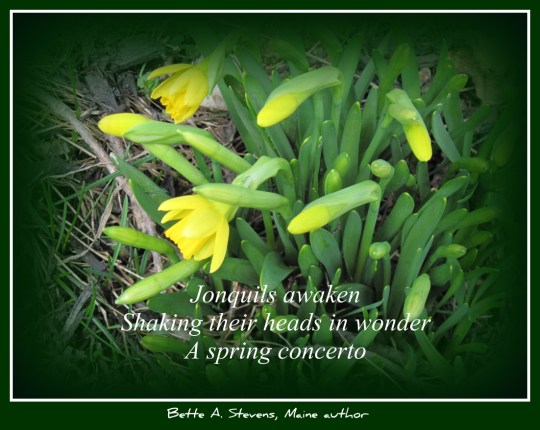
As I wandered out into the garden with my trusty camera early this morning, much to my surprise, an icy blanket at the edge of the rock garden had melted and a family of opening jonquils greeted me with their smiles. Being the first blooms of the season, they simply made my day and inspired me to write “A Spring Concerto,”  a haiku (Japanese-inspired, non-rhyming three-line: 5-7-5 syllable poem).

A Spring Concerto
HAIKU by Bette A. Stevens

Jonquils awaken

Shaking their heads in wonder

A spring concerto

Personally, I love designing  posters to go with my poems and often use photos I have taken. As a former teacher (now retired) in grades four through eight, I know that kids of all ages love writing poetry and they enjoy illustrating their poems too. It’s simple and it’s so much fun to tell a story in the three short lines of Haiku. Of course, you can write as many stanzas as you wish. Today’s a perfect day for you to give it a try.

Get out your pen, get outdoors in nature, get inspired…and get the kids writing haiku too!

~Bette A. Stevens, Maine author/illustrator

(Haiku: m)

haiku

noun hai·ku \ˈhī-(ˌ)kü\

plural

haiku

  1. :  an unrhymed verse form of Japanese origin having three lines containing usually five, seven, and five syllables respectively; also :  a poem in this form usually having a seasonal reference — compare tanka


Discover more about how to write haiku and other poetry:

Find out more about International Haiku Poetry Day

[Explore Bette’s Blog]

Save

Save

Save

Save

Save

Aside

How to Characterize Love in Your Writing


GREAT TIPS & RESOURCE LINKS…
Happy Love Month & Happy Writing! ~Bette A. Stevens http://www.4writersandreaders.com

Jacqui Murray's avatar

valentineI posted this last year, but it’s worth repeating: How do we characterize love in your writing?

Because, if you’re a writer, you must. It doesn’t have to be sex but it has to take readers that direction, right to the edge of the cliff. Yes, you can leave the lurid details out, but let readers peek over the edge.

How do you do that? Start with a few decisions:

  • Is it platonic?
  • Is it unrequited?
  • Is there conflict?
  • Is it lust disguised as love?
  • Is it serial love? Or one-of-a-kind?
  • Is it kinky or traditional?
  • Does love bring joy or sadness–or misery?
  • Is the manifestation of love baby-ish or mature–goo-goo eyes and saccharin words or Paris vacations?
  • Is love verbal or silent?
  • Is this love constructive or destructive? Flowery or brutal?
  • what part does the spiritual play in the emotion–or is it uninvolved?
  • Is it a subplot or a…

View original post 672 more words

Tag Cloud